
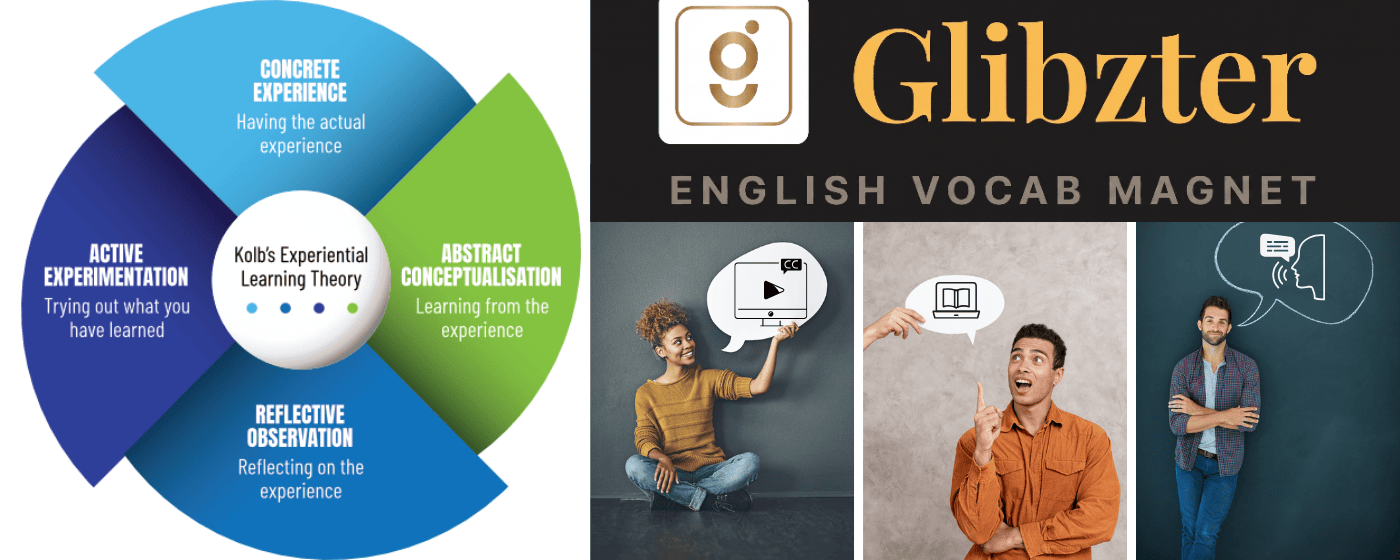
Understand how Glibzter has implemented the principles of Kolb's Experiential Learning Cycle into its AI Product offering to help students, working professionals and English language enthusiasts communicate in English with greater confidence.
At Glibzter, we have this abiding belief that "Lexis is the basis for any language". It means that words and phrases are the building blocks of the language we speak. Language consists not of traditional grammar and vocabulary but often of multi-word prefabricated chunks called collocations - an admixture combination of words, which we use depending on the context we are in.
English Vocabulary acquisition stands as the foundational pillar supporting all four core communication skills: listening, speaking, reading, and writing. Yet, traditional vocabulary learning methods often rely on monotonous, rote memorization from static word lists for preparation for competitive entrance exams like CAT, SAT, GRE, GMAT etc. as well as preparation for English tests such as IELTS, TOEFL and PTE.
Recent educational research highlights a powerful alternative. A 2026 classroom-based study with 70 undergraduate engineering students from SRM Institute of Science and Technology (Chengalpattu, Tamil Nadu, India) published in the Journal of English Language Teaching (JELT) by the English Language Teachers Association of India (ELTAI) demonstrated that structuring vocabulary learning through immersive film-based learning and application of David Kolb’s Experiential Learning Cycle yields exceptional results. By shifting the learning environment from rigid textbooks to authentic multimedia experiences, students exhibited massive boosts in engagement, confidence, and contextual word mastery.
Digital Consumption Habits
Before we get down to the insights from the research paper findings, it will be interesting to get some of the latest numbers associated with digital content consumption:
Online Videos
The average user spends roughly two hours and 39 minutes on social media daily, adding up to more than 40 days a year. If we add it all together, the world collectively spends 11.5 billion hours on social media platforms daily.
While Meta's social channels such as Instagram and WhatsApp are mobile-first, LinkedIn and X.com have incredibly strong desktop footprints among corporate employees and academics.

Passive Content Consumption to Active Learning Experience
Most of the digital content consumption is passive (barring reading news or e-books). What if there was a way to integrate a system of language learning and improved retention into such digital channels?
Glibzter English Vocab Magnet browser extension directly operationalizes Kolb’s Experiential Learning Cycle. Designed for consumer technology users, this AI-powered tool transforms passive web browsing, video streaming, and news reading into an active, structured vocabulary expansion journey.
Principle 1: Concrete Experience | Immersive Interaction with Digital Content
Research: In the published research paper in ELTAI's journal, researchers achieved immersive content interaction by screening an authentic English film with subtitles, enabling students to encounter the English language subconsciously within a real-world context.
Glibzter English Vocab Magnet mirrors this principle seamlessly within your daily digital content consumption routine. As you watch your favorite shows on video streaming platforms with subtitles or read online news portals, the browser extension serves as your digital companion. Instead of interrupting your flow with dense dictionaries, it allows you to experience authentic English naturally. The tool honors Michael Lewis’s Lexical Approach, which posits that language consists of meaningful multi-word prefabricated chunks rather than isolated words. By curating real-time vocabulary (not just words but also word combinations or collocations such as phrasal verbs, idioms and domain specific jargon), Glibzter ensures you absorb language exactly how it is used by native speakers.
Principle 2: Reflective Observation | Curation of Words and Phrases
Research: In the published research paper, students had to identify and discuss unfamiliar words they came across during the film screening along with their meanings.
Glibzter English Vocab Magnet automates and enhances this entire cognitive process using advanced AI. It magnetizes and highlights the high impact English words as well as phrases (word combinations such as phrasal verbs, idioms and select collocations) from the digital content in yellow on the interface of the online article, and in the home page of the web app as a curated list under Words Acquired and Phrases Acquired.
Users can click on the word or phrase to know the meaning (in English or in their native language) as well as how that word or phrase was used in the source (video or online article).
Principle 3: Abstract Conceptualization | Meanings and Usage
Research: The researcher, drawing on the Lexical Approach, led a teaching segment giving an outline for a word by providing definitions, synonyms, and usage examples.
The Home page of the Glibzter English Vocab Magnet web app is where all the curated words and phrases identified and acquired by the browser extension get listed. The user will have to tick the checkbox against the word or phrase they wish to contextually practise. This is also the first step where the vocabulary acquisition turns into contextual application knowledge through understanding the meaning and how it was used in a sentence.
This immediate feedback loop satisfies the critical need for repeated word exposure and contextual understanding. It effectively transitions a user from merely noticing a word to comprehending its underlying lexical patterns, moving vocabulary from short-term memory into long-term cognitive retention.
Principle 4: Active Experimentation | Forming Original Sentences
Research: Students formed a new original sentence using the newly learnt vocabulary, thereby understanding and practically applying the new knowledge
In the "Test Verbal Skills" page of Glibzter English Vocab Magnet web app, the users are assessed not just on their lexical knowledge of the word or phrase, but also in contextually applying them in the form of a sentence. After selecting a minimum 15 words/ phrases for contextual practise, the users will find an assessment generated in the web app containing multiple choice questions (testing lexical knowledge) and speech/ writing input based questions (testing contextual usage in the form of a sentence creation).
Going a step further, Glibzter English Vocab Magnet web app's "My Performance" section gives users quantified data on their learning outcomes on a daily, weekly and monthly basis.
Key Insights from other Research Papers

The empirical study by Krishna, Suneetha, and Basha (2022) explores the role of English-language newspapers in developing vocabulary among ESL engineering students.
The research explores the idea that traditional classroom instruction alone is not sufficient for lexical growth; therefore, the researchers investigate how authentic materials, specifically newspaper articles, can enhance vocabulary acquisition. A questionnaire was created to test the students’ abilities across synonym and antonym recognition, word families, sentence formation, and lexical simplification. The study concluded that the results showed a vast majority (91.5%) of students were eager to acquire vocabulary through newspapers, indicating a strong interest among the students.
Gomathi et al. (2017) explores how films enhance vocabulary learning among first-year engineering students in India; the study focused on investigating the English movie Slumdog Millionaire. The researcher highlighted the potential of audiovisual media to engage learners in authentic and contextual language exposure. The study’s findings revealed that learners benefited from repeated word exposure, contextual understanding, and interactive classroom discussion.
Through this film-based activity, students confirmed that the activity is both enjoyable and motivating for their outcomes. Ultimately the study concludes that film-based intervention acts as an effective pedagogical tool for language development, particularly in vocabulary enrichment. The intersection of multimedia tools like films in the classroom has the potential to spark a dynamic pedagogical resource.
In Summary
The findings of the research study conducted at SRM Institute of Science and Technology (Chengalpattu, Tamil Nadu, India) are clear: integrating an experiential learning model with a lexical approach leads to superior sentence accuracy, higher retention, and a profound boost in learner confidence.
The intervention used the lexical approach emphasizing learning vocabulary in meaningful chunks from authentic film dialogues. Phrases like “reign supreme” and “fierce opposition” were encountered and discussed leading to deeper understanding through contextual learning.
Most learned words, like "Ajar," "Leige," and "Endeavour," were successfully mastered by over 70% of students, resulting in high rubric scores. The researcher was able to observe that by the end of the intervention, students began to use the learned words in discussions with their friends.
Glibzter English Vocab Magnet translates these research insights into a systematic process of vocabulary expansion for the digital age using the power of AI and Machine learning technology. By turning the videos you watch and online articles you read on the internet into your learning material, Glibzter ensures that students, corporate professionals, and language enthusiasts experience the fastest, the most engaging and systematic way to acquire, acquaint and contextually master vocabulary for more effective and impactful communication in English.
Access the research paper published in the Journal of English Language Teaching of ELTAI: